Category: Business News

  • O2 Centre looks to start-ups to boost food offer

    O2 Centre looks to start-ups to boost food offer

    People don’t tend to salivate at the prospect of shopping centre dining. Indeed, in some places it seems we’ve barely moved on since the days when a jacket potato with chilli was considered cutting-edge cuisine.

    Yet, on the eve of another restaurant opening there – Frankie & Benny’s starts trading Monday – the O2 Centre on Finchley Road is showing signs of becoming a dining destination, especially as two more intriguing eating places have popped up in and among the more familiar chains. Not that it’s easy for these start-ups to mix it with the big boys. It take determination and a keen understanding of what the centre looks for from restaurants.

    Falafel City, on the upper floor, was founded by Mitan Sachdev and his wife Kajal in 2011. It took them two years to refine their recipes and bring their product to market – and, crucially, to find the right location to open their first restaurant.

    Mitan and Kajal Sachdev
    Kajal and Mitan Sachdev

    Mitan gave up his career at accountancy firm PricewaterhouseCoopers to follow his dream of becoming a restaurateur. Kajal developed all the recipes. “She’s an amazing cook”, he says. The couple has created what they believe to be a unique concept: freshly-cooked falafels with an international twist, served in a bright and buzzy fast-food environment.

    One of the main hurdles for the fledgling business was finding suitable premises to rent. From the outset, the Sachdevs knew that they wanted their business to be surrounded by premium brands, but with no track record of running a restaurant, many retail landlords were reluctant to take them on.

    The O2 Centre unit was ideal, says Mitan, who’s far removed from the clichéd streetfood vendor parking a van in a south London carpark. “We’re grateful to the O2 Centre management for taking a bit of a punt” he says. Perhaps reflecting his corporate background he adds, “I always wanted to be near a Vue, and near a Virgin Active.” How convenient!

    It’s clear that branding has played a big part in Falafel City’s success. “If you want to play with the big boys, you have to look the part,” explains Mitan. Indeed, Falafel City, with its distinctive rotating sign, fits in comfortably alongside its nearest neighbours Byron and Yo! Sushi.

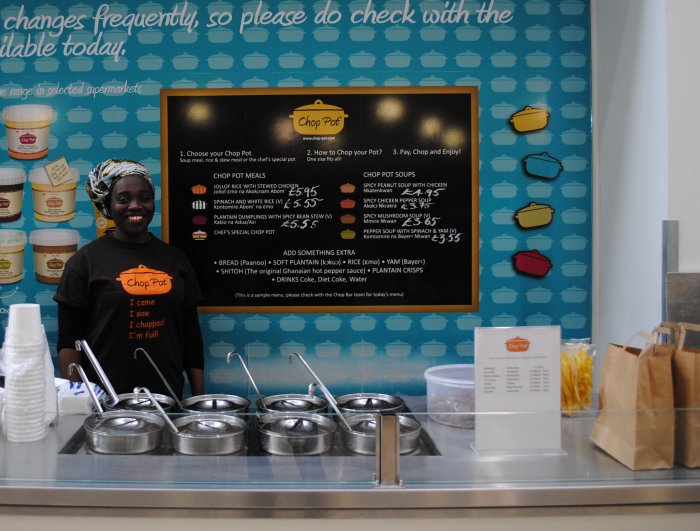
    Affia Bioh has a similar story. Affia gave up her job in banking to start selling Ghanaian food. After successfully testing the market with a chilled range, which Selfridges took on and still sell in its food hall, she wanted to branch out to a “Chop Bar”. The result: Chop Pot, which sits opposite Waterstone’s on the ground floor on the way to Sainsbury’s and sells hot takeaway food.
    Affia Bioh at Chop Pot
    Affia Bioh at Chop Pot

    The O2 Centre was a logical location for Affia, who was born and raised in the area – she attended South Hampstead School for Girls and St Augustine’s in Kilburn. She likes the diversity of the local population. “Local people are very inquisitive about different cuisines and want to try them”, she says. She’s happy to talk customers through the different dishes, which are Ghanaian street food classics such as Jollof Rice, a spicy one-pot rice dish, and a deliciously rich chicken and peanut stew.

    Like the Sachdevs, Affia is pleased with the support she has received from the O2 Centre and recognises that it’s taking a chance on a small start-up business, and proud to be offering something different. “I’m carrying the torch for West African food in the O2 Centre,” she says proudly.

    Jason King, who manages the O2 Centre on behalf of owner Land Securities, says he welcomes the arrival of both Falafel City and Chop Pot. “There’s a lot of pressure on the shopping centre industry from online businesses, so the whole experiential side, such as food and leisure, is increasingly important.”

    For Jason, it seems that creating an environment where well-known chains rub shoulders with smaller players is an important means of differentiation. “It prevents that feeling of ‘every shopping centre looks the same’ which can creep in if you’re not careful.”

    He sees it as mutually beneficial: start-ups gain exposure and visibility, while the centre gets credibility by being able to boast a wide range of dining options. “In terms of the variety, we have a good mix. Byron is a great brand for us to have. Nando’s is still one of the big movers and shakers, and Yo! Sushi is a worldwide brand. It’s great to have them alongside small startups like Falafel City and Chop Pot, which is a lovely story of someone setting themselves up in business with a great product and lots of enthusiasm, but who have also got their branding to a level where it can fit in amongst the bigger players.”

    Once again, the importance of branding comes to the fore. “It’s got to feel right,” says Jason. “We’ve got a design guide in terms of what we want to see from shop fits. We’re not looking for conformity, but looking to set the bar at a certain level.”

    Anna Adamczyk, restaurant manager at Zizzi, one of the centre’s long standing tenants, agrees. “The new developments here are exciting for everyone – the local community and existing businesses. Hopefully by having more options for customers, the O2 Centre will become a destination for those looking for somewhere to have a bite to eat.”

    Centre manager Jason’s enthusiasm come to the fore as he talks about the changes underway; three new restaurants (Wagamama, Rossopomodoro and Frankie & Benny’s) are opening on the top level next to Falafel City. The work is scheduled to be completed by June or July, and the centre is planning a big launch event to promote itself as a dining destination. Zizzi also confirmed that its restaurant will be getting a refurb in July. It’s taken a while though, Wagamama and Rossopomodoro were first mooted at the start of 2013.

    Jason King has been at the O2 Centre since Land Securities bought it in 2010. The place has changed quite considerably in that time, both in terms of the brands it’s brought in and the physical changes to the building. The company is intent on creating the kind of place that people in the Swiss Cottage/West Hampstead area – and beyond – will want to spend time in. Goodbye Jurassic Park-style fake rock interior and Hello outdoor terrace, which will be shared between the three new restaurants, bringing al-fresco dining to the centre – even if al fresco does mean “view of Finchley Road traffic”.

    What do you think? Has the O2 Centre transformed into a dining destination, or is it still more of a pre-cinema pitstop? As ever, feel free to leave your comments below.
  • Brinkworth Dairy is local’s crème de la crème

    Brinkworth Dairy is local’s crème de la crème

    Winners

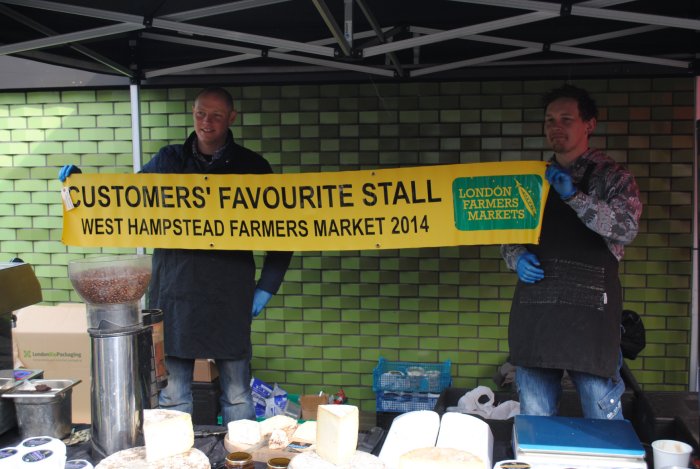
    West Hampstead Farmers Market has a new champion. Over four weeks of online polling, customers have voted Brinkworth Dairy as the market’s “Favourite Stall” of 2014.

    The dairy, which sells cheese, milk, butter and cream as well as serving top-notch coffee, gets to unfurl the coveted yellow banner for the next year over its stall, which is right at the end of the market.

    The dairy farm is based in North Wiltshire, and has been in the same family since it was taken over by William Collingborn in 1910. It has bred Friesan cows ever since in a closed herd.

    The cheese making business began in 2006, and 80 percent of its revenue is now from farmers markets such as West Hampstead. Ceri Cryer, great-granddaughter of William, and her husband Chad run this side of the business, while Ceri’s dad Joe runs the farm. Chad can usually be found manning the coffee machine at the stall.

    Ceri explains what’s special about the Brinkworth approach:

    Everything is really handmade. In the cheese making, we don’t even use any mechanical stirrers or cutters. This means the curd is handled really gently and means that the cheese is really creamy. It means we only produce small volumes (60kg) at a time. Even the milk is bottled by hand just using a small tap. Milk is better when it hasn’t been knocked around so much. The ice-cream is made in 3 litre batches at a time which makes it easy to do bespoke flavours. The yogurt is made in a unique way – again with little handling and our customers love it!

    Ceri’s own favourite product is the cream. “It’s so thick! It’s not double but quadruple cream”.

    Farmers markets may mean that producers can cut out the middle man, but they are still hard work. Brinkworth is at seven markets every week, two on a Wednesday, two on a Saturday and three on a Sunday (including Queens Park, where it won best stall last year). Different markets have different emphasis. Marylebone is all about the cheese, whereas milk and butter does well in West Hampstead as families use the market for more of their staples.

    What makes them the customers’ favourite. Chad reckons (sotto voce) that it might be that they’re good value!

    Brinkworth Dairy West Hampstead

  • Happy Birthday! Colour Division turns 40

    Happy Birthday! Colour Division turns 40

    If you’re interested in how West Hampstead has changed since the mid-1970s, you could do worse than have a chat with David Jacobs.

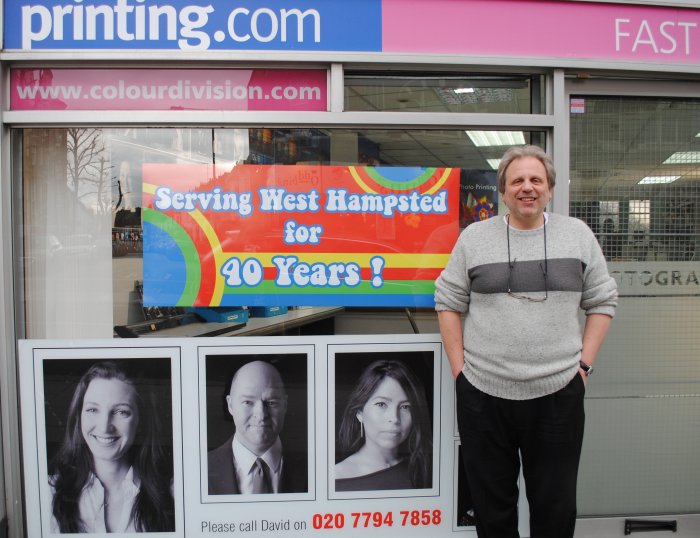
    Dave, as he’s known to his staff and customers, has been running print shop Colour Division from the same premises on West End Lane since day one, exactly 40 years ago today. He still remembers when “the only place you could get a cup of tea was the Wimpy Bar”.

    40 years and they still can't spell West Hampstead (never trustr a printer!)
    40 years and they still can’t spell West Hampstead (never trust a printer!)

    Things have moved on since then, not only on the West Hampstead gastronomic scene but also in the world of printing. Colour Division has seen huge changes since the early days when people queued out of the door to photocopy letterheads and fanzines. Today’s customers are more likely to request LinkedIn profile photographs or high-quality digital prints.

    One thing that remains constant is the long-standing staff members; alongside Dave, Steve Twohill has been working at Colour Division for 28 years, and Debbie Harris for the past decade.

    Dave and his team have built up a loyal local customer base over the years: “I think we’ve served virtually every small business in the area, many times over… from estate agents to doctors surgeries, to accountants and architects”, as well as innumerable one-person businesses and private individuals.
    “We’re very embedded in the community. Everybody seems to like us and like the service. We’ve got clients literally from day one still coming here, and now we’re serving their children.”

    Dave and Steve in action
    Dave and Steve in action

    Dave started the business with his brother Ivor who at the time was working for a magazine that needed a short-run printing service. Together with Fred and Sid Kenton, a couple of local printers, they set up Colour Division inspired by short-run instant printing services in the US. The business started under the challenging conditions of the Three Day Week – imposed by Edward Heath’s Conservative government to conserve electricity.

    Dave recalls more glamorous stories from the early days though – such as West Hampstead’s lively music scene of the time. “There was a big punk scene in West Hampstead” he says, which was centred on The Railway (formerly Klooks Kleek).

    He also told us about Colour Division’s role in the early days of iconic style magazine i-D, when it was produced from founders Terry and Tricia Jones’ house nearby. “i-D magazine started in West Hampstead. In the early days, the whole team used to come in. There were maybe six paste-up artists, they used to put it together here, and we printed it. It started off as a very basic thing.”

    The area may have changed beyond recognition, but Dave still believes it has the same community feel as ever. He is relaxed about the arrival of big chains on West End Lane: “People knock all these big chains moving in, but actually everybody uses them.”

    He continues “It’s a myth that West Hampstead is a village, but it does have a villagey feel. People have said to me ‘I’ve never been to a place where people say hello to each other’. Those are some of the best things. It’s the friendliness of everybody. It’s a people area.”

    What are the downsides of West Hampstead? Dave says that the parking restrictions mean that he loses out on a lot of business. “The parking’s impossible, from a commercial point of view. I reckon we’ve lost the potential for 25% of business.” He’d also like to see new businesses come into the area: “There’s too much focus on people escaping during the day; we need more business units – more small studios would be good.”

    He’s also upfront about the fact that, with ever-increasing overheads and decreasing margins, times are hard. “I’m enthusiastic about the business, but there’s more stress than ever because of the financial constraints. The banking crisis has been really tough on small businesses”.

    Will Colour Division introduce 3D printing to West Hampstead? The business has managed so far to keep up with new developments in the industry and Dave isn’t ruling anything out. However, he says the technology isn’t quite there yet. “Maybe in a couple of years.” You heard it here first!

    Dave is clearly passionate about hearing his customer’s stories. One of Colour Division’s services is professional portrait photography – they even have a studio downstairs – and as he flicks through his portfolio, it’s clear that he’s proud of the shots. He also knows what everyone does. “We like people. We want to talk to you about your job.”

    "You tend to remember the people behind the jobs. That keeps it interesting"
    “You tend to remember the people behind the jobs. That keeps it interesting”

    It’s the variety of work, and the customers and stories behind each assignment, that keep things interesting for Dave. As well as jobs for large business clients, people come in with requests for photographs of newborns, or wedding invitations, or funeral orders of service.

    In Dave’s own words, “It’s an unusual business, I would say. There are so many different types of jobs. You tend to remember the people behind the jobs. We’ve seen life here in the raw. That keeps it interesting.”

    Since the demise of the Wimpy, where does Dave go for a cup of tea now? True to his comment earlier that people still use the chains, you’re most likely to find him clutching a Starbucks.

  • Don’t Dispense So Close To Me

    Don’t Dispense So Close To Me

    pharmacies

    Once upon a time there were two pharmacies on Mill Lane. They were about 200 metres apart. But not for long.

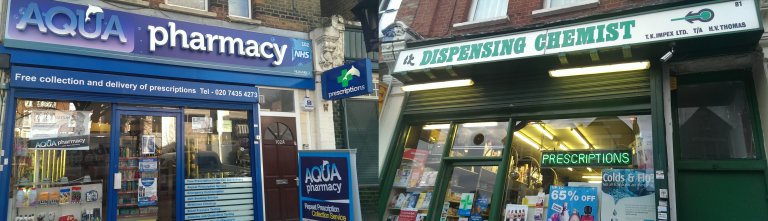
    Aqua Pharmacy, at 102 Mill Lane, is planning to move to 59 Mill Lane, which has been occupied by Escott’s upholsterers for many years. This would bring it just 10 doors away from T. K. Impex pharmacy (81 Mill Lane). T.K. Impex isn’t happy. The move is planned for May/June.

    At stake would seem to be the trade from patients walking back from the West Hampstead Medical Centre on Solent Road. Once, those that turned left would probably go to Aqua for their prescriptions and those that turned right would go to T.K. Impex. Aqua’s impending move means it becomes the nearest option for everyone coming up from Solent Road.

    Sanjay Patel, the Aqua pharmacist, has owned the chemist for the past three years. He insists that there is nothing sinister behind his desire to relocate. Worried about ever-increasing rents, and with the lease about to expire on his current premises, he took the opportunity to buy the freehold on the Escott’s building in order to have more control over his business. Mill Lane may appear to have many empty ground floor units but the reality is, one local estate agent told us, that few landlords are willing to sell their freeholds at the moment.

    Aqua plans to move in to where Escott's has been
    Aqua plans to move in to where Escott’s has been

    The Escott’s unit is about the same size as Aqua, he says, and he has ambitious plans to modernise it and improve his shop’s offering and customer experience. From his point of view, this is a sensible way of protecting his business. The advantage of being a freehold owner is, he says, “the only driver for the move”, and his intention is not to take business away from anyone else.

    Unfair advantage?

    Kim Khaki has run T.K. Impex for more than 30 years, and is unhappy with Aqua’s proposed move. He views the relative newcomer as a threat to his business and feels Aqua will have an unfair advantage because it will be the first pharmacy people see when turning onto Mill Lane from Solent Road. Aqua’s new premises is also very near the post office and bus stops, so he is worried that patients may go there for the convenience factor.

    He also expressed concern that having two pharmacies in such close proximity is “not adding any value to the West Hampstead community” of which he feels very much a part.

    T.K. Impex, somewhat confusingly, is also known by its trading name of H. V. Thomas (the name of the previous owner who ran the pharmacy for 45 years before Kim took over). It is, however, testament to the current owner’s personality and dedication that despite the various names above the door, the shop is known to its regular customers simply as “Kim’s”. He does seem to have an extremely loyal client base of his own, with some customers signing a petition to protest against Aqua’s application to move closer.

    Indeed, Kim is proud of the longstanding relationships he has built up with patients, and the personal service he and his staff provide. On our visit to the traditional-looking chemists, a steady stream of customers arrived for prescriptions, advice, or just a chat, including eminent local historian Morris Beckman who, at 94, has been a regular visitor to the shop for many years.

    Sanjay certainly believes that regular customers tend to remain loyal to a particular pharmacy, having built up a trusting and personal relationship, sometimes over many years. He expects Aqua’s regular clientele to follow it down the road to its new address and, likewise, for the regular users of T. K. Impex to keep going there. He is keen to emphasize that he “will not be changing the patient base”.

    Kim accepts that there is little he can do to block the move, but feels that it goes against an unwritten pharmacists’ code of conduct. Any pharmacy move needs regulatory approval but as Aqua is moving only 140 metres and will continue to provide the same services, it will almost certainly be deemed to be a “relocation which does not result in significant change” to local patient groups.

    Kim, however, asserts that as well as damaging his business, Aqua’s relocation will inconvenience patients at the other end of Mill Lane, who will now have to walk farther. He believes it would make more sense for Aqua to relocate in the other direction, as the nearest chemist’s that way is far away on Manstone Road off Cricklewood Broadway.

    Sanjay counters this by pointing out that Kim’s chemist is nearer to the Cholmley Gardens GP practice, so patients there will continue to take their prescriptions to their regular chemist. He is confident that there are enough customers in and around Mill Lane to support both businesses, and that as they offer different services and products, they will each keep their regular clientele.

    Will this be a case of “let battle commence”, or is it more likely that each pharmacy’s loyal customers will stick with what (and whom) they know?